
Life Satisfaction and its Relation to Self-Efficacy of Students in the College of Physical Education and Sports Sciences/ Tikrit university
Article Sidebar
Main Article Content
Abstract
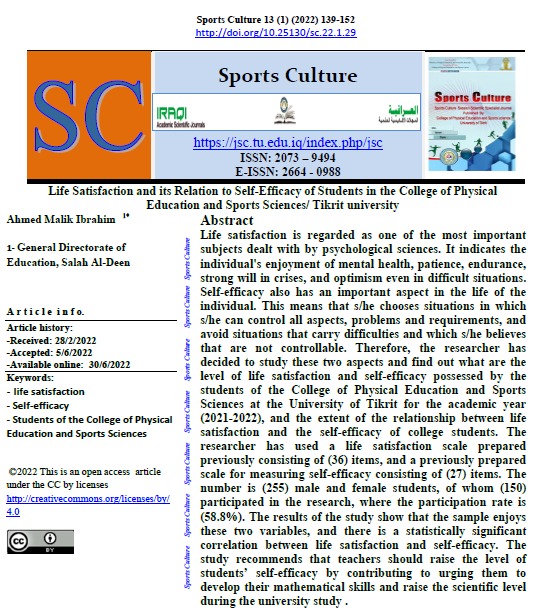
Life satisfaction is regarded as one of the most important subjects dealt with by psychological sciences. It indicates the individual's enjoyment of mental health, patience, endurance, strong will in crises, and optimism even in difficult situations. Self-efficacy also has an important aspect in the life of the individual. This means that s/he chooses situations in which s/he can control all aspects, problems and requirements, and avoid situations that carry difficulties and which s/he believes that are not controllable. Therefore, the researcher has decided to study these two aspects and find out what are the level of life satisfaction and self-efficacy possessed by the students of the College of Physical Education and Sports Sciences at the University of Tikrit for the academic year (2021-2022), and the extent of the relationship between life satisfaction and the self-efficacy of college students. The researcher has used a life satisfaction scale prepared previously consisting of (36) items, and a previously prepared scale for measuring self-efficacy consisting of (27) items. The number is (255) male and female students, of whom (150) participated in the research, where the participation rate is (58.8%). The results of the study show that the sample enjoys these two variables, and there is a statistically significant correlation between life satisfaction and self-efficacy. The study recommends that teachers should raise the level of students’ self-efficacy by contributing to urging them to develop their mathematical skills and raise the scientific level during the university study .

